This article is for informational purposes only and does not constitute financial, legal, or insurance advice. Always consult a licensed insurance professional before making purchasing decisions for your company.
Every dollar counts when running a company, but one lawsuit can wipe out your hard-earned revenue overnight. Securing the right business liability insurance is non-negotiable for US businesses in 2026. Whether you are a sole proprietor or managing a 50-person crew, maintaining proper coverage protects your assets against unpredictable accidents and the rising tide of costly third-party litigation.
💡 Key Takeaways: 2026 Market Data
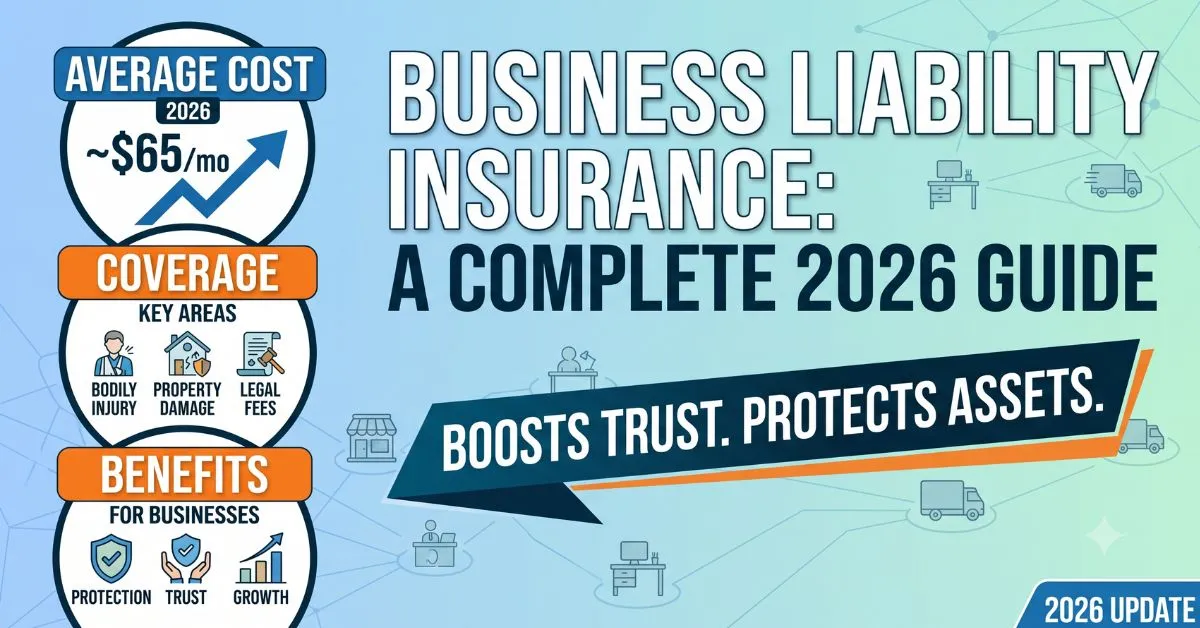
- Average Premium: Most US small businesses pay between $42 and $79 per month (roughly $500–$950 annually) for standard general liability coverage.
- Coverage Baselines: Over 85% of companies opt for the industry-standard $1 million per occurrence / $2 million aggregate policy limit 👉 Insurance Information Institute .
- Market Shifts: Premium rates rose by an average of 7.8% entering 2026, largely driven by inflated medical costs and legal “nuclear verdicts” 👉National Association of Insurance Commissioners .
- Cost-Saving Strategy: Bundling general liability and commercial property into a Business Owner’s Policy (BOP) remains the most effective way to lower overall rates
What Is Business Liability Insurance? (2026 Guide)
Business liability insurance protects your company’s financial assets if you are sued over third-party injuries, property damage, or reputational harm. If a customer slips in your office or an employee accidentally damages a client’s property, your policy can cover legal defense fees, settlements, and court-awarded judgments.
In 2026, third-party litigation funding and rising legal defense fees make baseline protection essential for every registered US entity 👉 U.S. Small Business Administration.
What It Covers (And Crucial Exclusions)
A standard Commercial General Liability (CGL) policy covers three main areas of risk:
- Third-Party Bodily Injury: Medical expenses, ambulance fees, and legal defense costs if a customer or vendor is injured on your premises.
- Third-Party Property Damage: Repair or replacement costs if you or an employee accidentally damage someone else’s physical property while working.
- Personal and Advertising Injury: Legal fees tied to claims involving slander, libel, copyright infringement in marketing, or false advertising.
However, standard business liability insurance comes with specific exclusions, which means separate policies may be required:
- Employee Injuries: Workplace accidents require statutory Workers’ Compensation 👉U.S. Department of Labor.
- Professional Mistakes: Negligence, contract breaches, or bad advice require Errors and Omissions (E&O) or Professional Liability.
- Auto Accidents: Work-related vehicle incidents require a dedicated Commercial Auto Insurance policy.
- Data Breaches & Ransomware: Customer data leaks and cyberattacks require specialized Cyber Liability Insurance.
Costs/Pricing: Average Premiums in 2026
Your actual business liability insurance cost 2026 depends heavily on your industry’s risk classification, payroll size, physical location, and claims history.
Low-risk professional services typically pay significantly less than businesses with heavy public foot traffic or physical labor operations:
- Consulting & IT Services: $25 – $40 / month ($300 – $480 / year)
- Retail & E-commerce: $45 – $70 / month ($540 – $840 / year)
- Restaurants & Hospitality: $75 – $130 / month ($900 – $1,560 / year)
- General Contracting & Trades: $90 – $210+ / month ($1,080 – $2,500+ / year)
Across the broader US market, underwriting metrics show an average baseline increase of 7.8% year-over-year, largely driven by social inflation and higher jury settlement benchmarks.
How to Choose Your Coverage Limits
Most commercial landlords and enterprise clients require a minimum $1M / $2M limit:
- $1 Million Per Occurrence: The maximum amount your carrier pays for a single claim or incident.
- $2 Million Aggregate: The absolute ceiling your insurer pays across all combined claims within a one-year policy term.
Choosing a deductible between $500 and $1,000 remains the sweet spot for keeping annual premiums low without creating an unbearable out-of-pocket burden when a claim occurs.
Pros & Cons / Alternatives: General Liability vs. BOP
Choosing the right structure for your business liability insurance comes down to balancing cost, convenience, and risk exposure. For many small-to-medium operations, buying standalone General Liability (CGL) leaves physical assets unprotected. A Business Owner’s Policy (BOP) combines general liability with commercial property and business interruption coverage, often at a 10%–20% discount.
Policy Comparison: Which Structure Fits Your Business?
| Policy Type | What It Covers | Best For | Typical Monthly Cost |
|---|---|---|---|
| Standalone General Liability | Bodily injury, property damage, advertising injury | Service businesses, remote consultants, low physical asset exposure | $25 – $50 |
| Business Owner’s Policy (BOP) | General liability + commercial property + business interruption | Brick-and-mortar stores, restaurants, offices with equipment | $55 – $110 |
| Professional Liability (E&O) | Work errors, contract disputes, missed deadlines, negligence | Agencies, lawyers, tech consultants, financial planners | $45 – $95 |
Pros and Cons of Standard General Liability
- Pros:
- Client & Contract Compliance: Helps unlock commercial leases and meet vendor contractual requirements with an immediate Certificate of Insurance (COI).
- Affordable Baseline: Provides multimillion-dollar protection against catastrophic slip-and-fall or property claims at an entry-level price point.
- Flexible Underwriting: Fast approval processes with minimal paperwork are often available for low-risk business classifications.
- Cons:
- No Property Protection: Does not cover your own computers, inventory, tools, or physical office space if damaged or stolen .
- Zero Professional Error Shield: Does not protect against claims arising from flawed advice, software bugs, or contractual disputes.
- Excludes Cyber and Auto: Requires supplemental riders or separate policies to address ransomware attacks or fleet accidents.
Step-by-Step Action Guide: Buying Business Liability Insurance
Follow this streamlined 4-step framework to secure coverage without overpaying:
- Calculate Your Risk Exposure: Assess your physical location footprint, how often you interact with clients, and the value of your high-value tools. If you provide professional advice or technical deliverables, plan to pair CGL with .
- Determine Mandatory Limits: Check your commercial lease and major client agreements. Most enterprise master service agreements (MSAs) require a minimum $1,000,000 per occurrence / $2,000,000 aggregate limit.
- Compare Quotes Across Multiple Carriers: Request quotes from at least three top-rated commercial insurers or use a digital brokerage. Always verify the carrier’s AM Best financial strength rating, aiming for A- or better.
- Request and Store Your COI: Once bound, immediately obtain your Certificate of Insurance (COI) and confirm that your business name, address, and additional insured endorsements precisely match your client requirements.
Expert Verdict: Navigating Rising Litigation Risks
As commercial insurance premium rates continue trending higher, choosing a solid policy is about strategic risk management, not simply buying a generic commodity. Inflationary pressure on medical costs and rising legal verdicts mean an underinsured claim can trigger immediate insolvency for a growing venture .
For 2026, the smartest approach is to bundle your standard liability into a comprehensive Business Owner’s Policy while keeping a manageable $500 to $1,000 deductible. Review your policy annually whenever your payroll grows, new physical locations open, or high-value contracts are signed.
Frequently Asked Questions About Business Liability Insurance
How much does business liability insurance cost in 2026?
In 2026, standard business liability insurance costs small businesses an average of $42 to $79 per month ($500 to $950 annually). Your final premium depends on factors such as your specific industry classification, claims history, annual revenue, and selected coverage limits.
Do I need business liability insurance if I work from home?
Yes, because standard homeowners and renters insurance policies explicitly exclude commercial operations and work-related liabilities. A standalone business liability policy can protect your personal savings if a visiting client, courier, or vendor is injured on your property.
What is the standard coverage limit for small business liability insurance?
The standard baseline coverage across the US is a $1 million per occurrence and $2 million aggregate policy limit. This limit structure meets virtually all standard commercial lease requirements, vendor contracts, and client master service agreements.
What is the difference between General Liability and Professional Liability?
General liability covers physical incidents such as customer slip-and-fall injuries, property damage, and slander claims. Professional liability (Errors and Omissions) covers financial losses caused by flawed advice, missed deadlines, software bugs, or contractual disputes.
How do I get a Certificate of Insurance (COI) after purchasing a policy?
You can download your Certificate of Insurance instantly online through your insurance carrier’s customer portal as soon as your policy is bound. Most carriers allow you to add clients as “additional insured” parties and generate customized COI PDFs on demand at no added charge.
Read This Also : Best Online MBA Programs 2026: Top US Rankings & ROI Guide
Conclusion
Securing dependable business liability insurance is a fundamental part of modern operational risk management in 2026. Rising legal costs and inflationary settlement trends make proactive protection of your balance sheet more important than ever. By identifying your industry-specific exposure, maintaining an adequate $1M/$2M policy limit, and bundling coverage through a Business Owner’s Policy where possible, you can scale your operations with greater confidence and long-term financial resilience.